The ITIL is a set of concepts and practices for Information Technology Services Management(ITSM), Information Technology development and IT operations
ITIL gives detailed descriptions of a number of important IT practices and provides comprehensive checklist, tasks and procedures that any IT organization can tailor to its needs
ITIL – Basic Concepts
Good practice – ITIL is presented as a good practice or correct method, an approach that has proven itself in practice
Service – is a means of delivering value to customer by facilitating outcomes the customer want to achieve without the ownership of specific costs or risks
Service management – a set of specialized organizational capabilities for providing value to customers in the form of success.
Some principles of Service Management
Specialization & co-ordination – the goal of service management is to make capabilities and resources available through services that are useful and acceptable to the customer
Including quality, costs and risks
Service provider takes the weight of responsibilities off the customer’s so they can focus on core business
Agency principle – may be consultants, advisors or service providers, act as intermediary between service providers and customers
Value – is the core of service concept, from the customer’s perspective consist of two core components, utility and warranty, what the customer receives and how it is provided
Encapsulation – customer interest focuses on the value of use, and spared from any technical details and structure complexity.
The encapsulation principle is focused on hiding what the customer does not need and showing what is valuable and useful to the customer
Systems – is a group of interacting, interrelating or interdependent components that form a unified whole, operating together for a common purpose
Service management – is a set of specialized organizational capabilities for providing value to customers in the form of services
Function – is a subdivision of an organization that is specialized in fulfilling a specific type of work, and is responsible for specific end results
Process – is a structured set of activities designed to accomplish a defined objective, result in a goal oriented change and utilize feedback for self enhancing and self corrective actions, with measurable, specific results
The Service Lifecycle
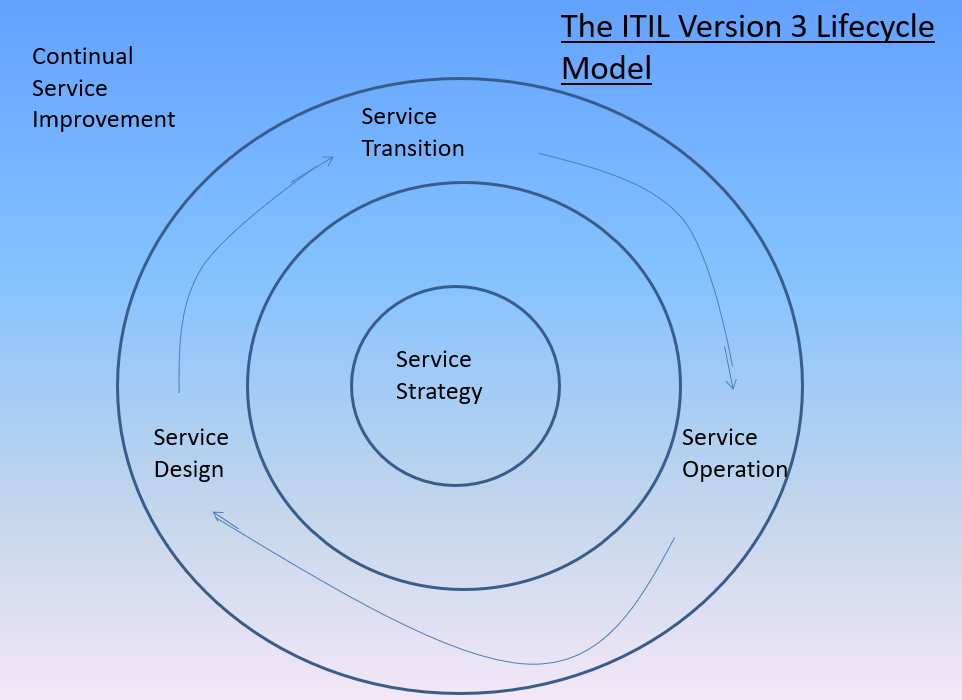
ITIL version 3 approaches service management from the lifecycle of a service.
It is an organization model providing insight into:
The way service management is structured
The way the various components are linked to each other
The impact that changes in one component will have on other system components and on the entire system
Service strategy – the phase of designing, developing, and implementing service management as a strategic resource
Service design – design phase of developing appropriate IT services, including architecture, processes, policy and documents
Service transition – the phase of developing and improving capabilities for the transition of new and modified services to production
Service operation – achieving effectiveness and efficiency in providing and supporting services
Continual service improvement – the phase of creating and maintaining the value for the customer by design improvement and service introduction and operation
Service Strategy
Guidelines that will help in setting customer- and market-oriented goals and expectations.
Helps in identifying, selecting and prioritizing opportunities(distinguishing capabilities).
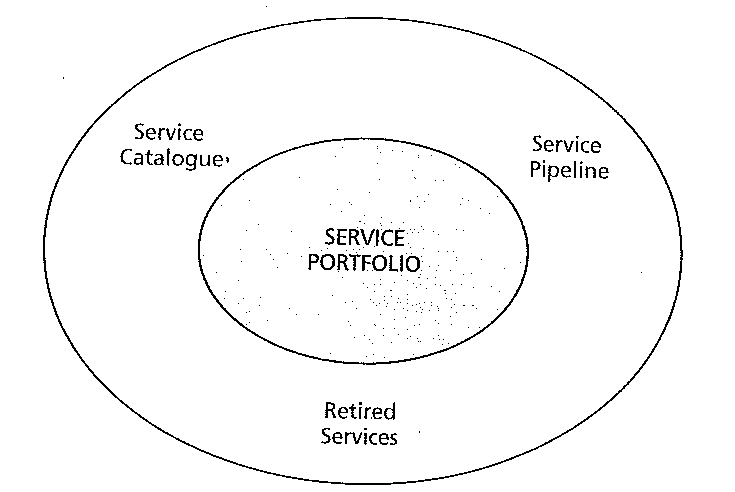
A clear service strategy helps to ensure that an organization is equipped to manage costs and risks within the Service Portfolios.
Help to maintain the link between policies and tactics.
Goal – to identify the competition and to compete with them by distinguishing oneself from the rest and by delivering superior performance.
The 4 P’s of service strategy- Henry Mintzberg
Perspective – have a clear vision and focus
Position – take a clearly defined stand
Plan – form a precise notion of how the organization should develop itself
Pattern – maintain consistency in decisions and actions
Perspective
Strategy is a perspective because it provides the vision and focus of an organization.
Defines the convictions, value and goals that govern the behavior of the entire organization
A strategic perspective determines the direction through which the service provider can achieve its objectives
Test – Are they clear and memorable, suitable for promoting and conducting activities, do they establish the boundaries within which people are free to experiment
Position
Strategy as position defines the distinguishing characteristics of the service provider in the eyes of the customer
Based on diversity, a limited catalogue of services, but with depth that diverse customers with similar needs can be served
Based on needs, a broad catalogue of services that delivers to a specific type of customer
Based on accessibility, possibility to deliver services to customers with specific needs such as location, scale or structure
Plan
Strategy as plan focuses on the organization’s action plan in a competitive market – how an organization handles a development
Service management is a co-ordinated set of plans through which service providers plan and implement service strategies
Pattern
Strategy as pattern represents an organization’s procedures.
As a consequence of the perspective, position and plan of the strategy, characteristic patterns are created and lead to recurring successes
To form the Mission and Objectives
What kind of services must we offer and to whom?
How do we stand out above the competition?
How can we justify strategic investments?
How can we actually create value for the customer and our stakeholders?
How can we efficiently allocate resources in a Service Portfolio?
How can we use financial management to ensure insight and control over value creation?
Service Value
ITIL uses two basic concepts for the value of a service
Utility – fitness for purpose. The attributes of the service that have a positive effect on the performance of activities, objects and tasks with specific results. Possible increase in profits.
Warranty – fitness for use. Availability and reliability in continuity and security. Decline in possible loses
The utility is what the customer receives, and warranty affirms how it will be delivered
Communicating Utility and Warranty
Warranty guarantees the utility of a service
Availability – services available according to agreed conditions
Capacity – affects the utility of most services
Continuity – service supports the business even during times of difficulty
Security – can make use of the service safely and securely
Service Structure
Who are the participants in the service
What are the patterns in exchanges and transactions
What is the impact or what are the products to be delivered from each transaction and each participant
What is the best way to generate value?
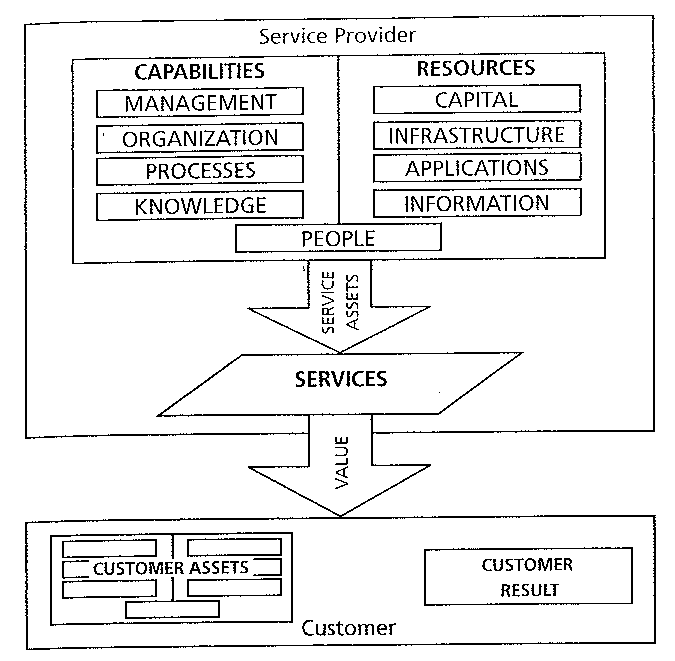
Service Assets
Resources
Based on experiences
Knowledge intensive, based on information
Deeply embedded in the people, systems, processes and technologies in an organization
Capabilities
Experience acquired through the number and variety of customers
Experience gained through problem solving, handling situations, managing risks and analyzing mistakes
Process – algorithms, methods, procedures, routines
Knowledge – realizations, experience, information intellectual property
People – capacity for creativity, analysis, leadership
Information – meaningful abstractions of
data that are applied in the context of
customers, contracts services
Application – automation and tools
supporting other asset types
Infrastructure – defined by the relationship
with other assets that they support
Financial capital – to support the use of all
Resources and Capabilities
Service Strategy Activities
Defining the market
Understanding the customer
Understanding the opportunities
Classifying and visualizing the services
The development of the offer
The development of strategic assets
Preparation for implementation
Defining the Market
Understanding the customer – know the performance of the customer’s assets
Understanding the opportunities
Classifying and visualizing services – service strategy results in a specific collection of patterns
Services vary primarily in how and in what context they create value
Developing the Offer
The consumer’s market
Result oriented definition of services
What kind of service
Who are the customers
How do the results create value
Service portfolio, catalogue
Strategic Assets
Increasing the service potential
Training, added core competencies
Increasing the performance potential
What does the market wants
Do we have something unique
does the implementation leads to desired results
Implementation
Strategic audit
Which services are distinctive, lucrative, effective
Setting goals – tasks, results and constraints
Defining critical success factors
Determine the success or failure of a Service Strategy
Factors influenced are customer needs, business trends, competition, supplier and regulation.
Investigation of business potential
Market that can best be serviced with existing assets
Synchronizing with customer’s needs
Expansion and growth
Extensions of existing contracts
Increasing requests
Expansion with complementary services
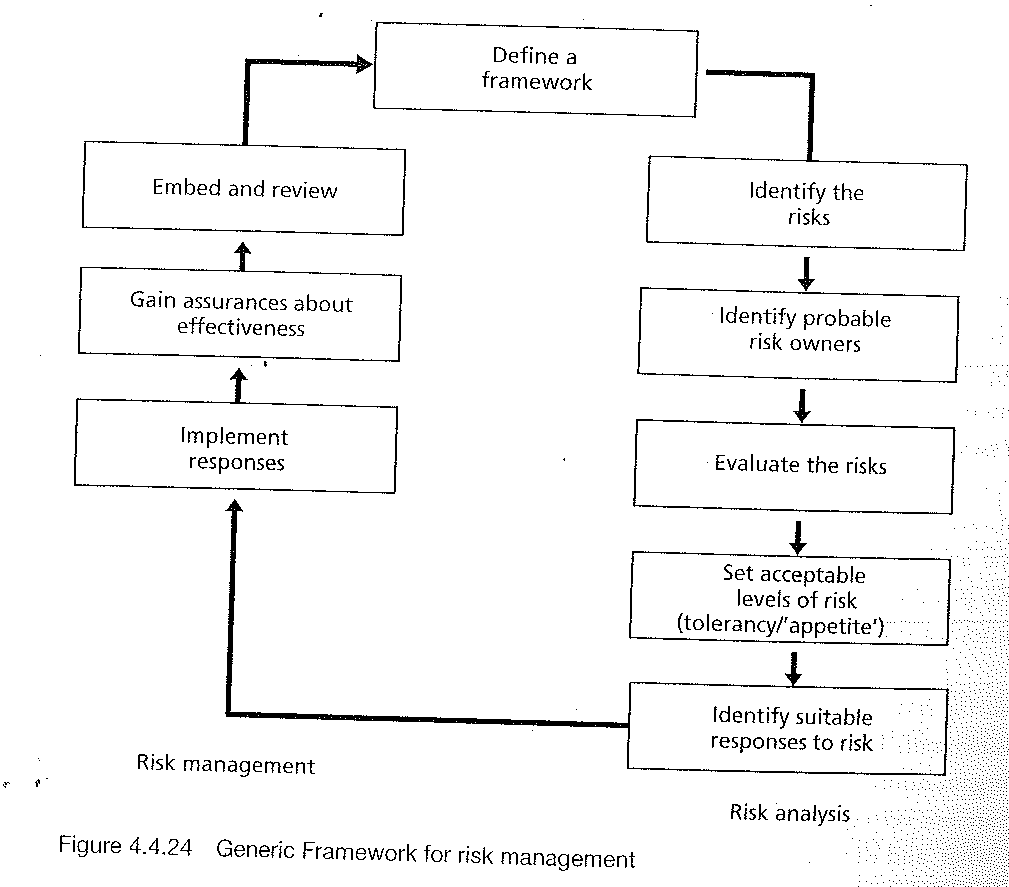
Two Phases of Risk
Risk analysis – is involved with the gathering of information regarding the exposure to risks
The organization makes the right decisions and overseas the risks in the appropriate manner
Risk management – ensures that there are processes in place that are focused on monitoring risks
Generic Framework for Risk Management
Types of Risks
Contract risks – service provider makes it impossible to satisfy the contractual agreements are strategic risks. Coordination throughout the entire lifecycle is necessary in order to manage this risk
Design risks – service achieve undesirable results, a performance risk, a result of bad design
Operational risks – for the business units and for the service units
Market risks – Effective service management reduces the competitive risk.
Market risks can be reduced through
Differentiation , provide assets that are scarce and not commonly provided
Consolidation of the demand reduces the financial risks
Service Design
To satisfy the needs and demands of the business, the design of effective and efficient IT services is a process of balancing the functionality, available resources and available time
Considering the mutual dependence of department, IT services cannot be designed, transitioned or implemented in isolation
Requires a holistic approach, clear communication and the requirement everyone can have assess
The design of a new or modified service for introduction into a production environment
Objectives –
To contribute to the business objectives
To contribute to saving time and money
To minimize or prevent risks
To contribute to satisfying the current and future market needs
To assess and improve the effectiveness and efficiency of IT services
To support the development of policies and standards regarding IT services
To contribute to the quality of IT services
Actions
New service must be added right from the concept phase of the service portfolio
The service level requirements(SLR) must be clear
Based on requirements, the capacity management team model these requirements within the existing infrastructure
If new infrastructure or more support needed, financial management involved
Before the implementation, a Business Impact Analysis(BIA) and risk assessment performed
This provides valuable information for IT Service Continuity Management(ITSCM), availability management and capacity management
The service desk must be brought up to speed regarding the new service delivery
Service Transition can make a plan for the implementation of the service
Supplier management must be involved if there are purchases to be made
Service Solutions
Analysis of corresponding requirements
Revision of existing IT services
Development of the services on the basis of new requirements
Content of service acceptance criteria
Evaluation of costs of alternatives
Agreed expenditure and costs
Evaluation and confirmation of benefits for the business
Decide on the desired solutions, results and objectives
Monitor the services in the light of overall strategies
Ensure that the corporate and IT governance and security controls are satisfied
Ensure functions effective and satisfies the requirements
Support agreements are necessary to deliver the service
Architecture Design
The development and maintenance of IT policy, strategies, architectures, design, documents, plan and process for deployment, implementation and improvement of appropriate IT services and solutions throughout the organization
It satisfies the needs of the business, its products and services
A proper balance is found among innovation, risks and costs
It conforms to relevant frameworks, strategies and policies
There is co-ordination among the designers, planners and strategists
Rapid Application Development(RAD)
The incremental approach
Service is designed bit by bit
Parts are developed separately and are delivered piecemeal
Each piece is supported by one of the business functions and together they support the whole
Advantage is a shorter delivery time
The iterative approach
Lifecycle is repeated many times through the design
Prototypes of the entire process are used in order to understand the customer requirements better
Commercial Off The Shelf Solutions
Standard software solutions to satisfy needs and demands
A framework is needed for the selection, modification and implementation
What requirements are set at the management and operational level, and how the package fits this requirements
Have an understanding on the advantages and disadvantages of such packages
Determine the requirements regarding the product, the supplier and the integration of the service package
Service Design Processes
Service Catalogue Management
Service Level Management
Capacity Management
Availability Management
IT Service Continuity Management
Information Security Management
Supplier Management
Service Catalogue Management
The development and maintenance of a service catalogue that includes details and status of all existing services and business processes they support, and those in development
Service Level Management
Represents the IT provider to the customer and the customer internally to the IT service provider
Goal is to take responsibility ensuring that the levels of IT service delivery are achieved
Includes the planning, coordinating providing agreeing monitoring and reporting of service level agreements
Capacity Management
Central point for all designs regarding IT performance and capacity issues
Ensure that the capacity corresponds to both the existing and future needs
Depends on the requirements
Availability Management
Availability and reliability have a direct influence on customer satisfaction
Goal is to ensure that availability level of services correspond with the levels as agreed with the customer
Achieve through the monitoring and reporting of the availability metrics and information systems
IT Service Continuity Management - ITSCM
Focus on continuity and recovery requirements
Goal is to support business continuity by ensuring that the required IT facilities can be restored within the agreed time
Focuses on disasters while less significant catastrophes handled through the incident management process
Information Security Management
Ensures the information security policy and corporate governance
A continual process and is an integral component of all services
Supplier Management
Attention to all suppliers and contracts to support the delivery of services
Goal is to guarantee a constant level of quality for the right price
A supplier and contracts database must be establish
Must be in sync with the demands of the organization
The process owner – responsible for ensuring that the process is implemented as agreed
Documenting and recording the process
Defining the KPI’s
Improving the effectiveness and efficiency
Providing input to the Service Improvement Plan
Reviewing the process, roles and responsibilities
The Service Design manager – responsible for the overall co-ordination and input of the Service Design tasks
Ensure the Service Strategy corresponds with the design process and satisfy the requirements
Design the functional aspects of the services
Produce and maintain the design documentation
Assess the effectiveness and efficiency of the design process
The Service Catalogue manager – responsible for the production and maintenance of the Service Catalogue
Ensure that the service are recorded in the Service Catalogue
Ensure that the information that has been included is up to date and is consistent with the information in the Service Portfolio
Ensure the catalogue is secure and that there are backups
The service level manager – responsibilities include
Have an insight into the changing demands of the customer and the market
Ensure that the customer’s existing and future requirements have been indentified
Negotiate and make agreements on delivery of service
Assist in the production and maintenance of an accurate service portfolio
Ensure that the objectives that have been ratified in underlying contracts are synchronized with the service level agreement
The Availability manager - responsible for
Ensuring that the existing services are available as agreed
Assisting in investigating and diagnosing all incidents and problems
Contributing to the design of the IT infrastructure
Proactively improving the availability of services
The Security manager – responsible for
The design and maintenance in information security policy
Assist in the business impact analysis
Perform risk analyze and management
Business Impact Analysis
BIA is a source of information for establishing the customer’s needs and the impact and the risk of a service
What are the critical services
What an acceptable time for the service to be unavailable
Level of unavailability
Cost of the loss of service
What are the critical business and service periods
Critical Success Factor / KPI’s
% of specification of the requirements of Service Design produced on time
% of specifications of the requirements of Service Design within budget
% of Service Transition packets produced on time
Accuracy of Service Design
Accuracy of SLA’s, OLA’s and contracts
Service Transition
How the specification from Service design can be effectively converted to a new or changed services
A Service Transition includes the management and co-ordination of the processes, systems and functions required for the building, testing and deployment of a ‘release’ into production and establish the service specified in the customer requirements
Goals
Goals include
Supporting the change process of the business
Reducing variations in the performance and known errors
Ensuring the service meets the requirements of the service specifications
Objectives
Objective include
The necessary means to realize, plan and manage the new service
Ensuring the minimum impact for the service which are already in production
Improving customers satisfaction and simulate the proper use of the service and mutual technology
Comprises of
Planning and preparation
Building and testing
Any pilots
Planning and preparation of the deployment
Deployment and transition
Review and closing of Service Transition
Service Transition Policies
Define and implement guidelines and procedures
Implement all changes through service transition
Utilize frameworks and standards
Reuse of existing processes and systems, promotes efficiency and effectiveness
Co-ordinate service transition plans with the needs of the business
Create relations with stakeholders
Set up effective controls to have smooth transition of service changes
Deliver systems for knowledge transfer and decision support
Plan releases and deployment packages , design, built, test delivered
Anticipate and manage changes in direction
Ensure stakeholders involvement in an early stage in the Service Lifecycle
Assure the quality of a new or changed service
Proactively improve the quality during a Service Transition
Service Transition Processes
Transition planning and support
Change Management
Service asset and configuration management
Release and deployment management
Service validation and testing
Evaluation
Service knowledge management
Transition Planning and Support
Design specifications and requirements of the production department in the transition planning process
Management of planning, support activities, transition progress, changes, issues, risks, deviations, processes, supported systems and tools
Monitoring of the performance
Communication with client, users, stakeholders
Change Management
A change is the addition, modification or removal of authorized, planned or supported service or service component and its associated documentation.
Activities are comprised of:
change and release plan
Review of request for change
Assess and evaluate change
Impact assessment
Authorize change
Plan, co-ordinate implementation
Evaluate and close
Service Asset and configuration Management(SACM)
Objective of SACM is to define the service and infrastructure components and maintenance of configuration records
Integrity, categorization in configuration management
Activities include management and planning, configuration identification and management, status accounting, verification and audits
Release and Deployment Management
Aimed at the building, testing and deployment of the service
Objectives and activities include:
Planning, preparation of building, testing and deployment
Transfer knowledge to clients
Minimal disturbances to the services
Review and close
Service Validation and Testing
Objectives and activities include:
Release fulfils the expectation of the client
Service are ‘fit for purpose’ and ‘fit for use’
Requirements are defined
Validation and test management
Preparing the test environment and testing
Evaluation and reports
Cleaning up and closure
Evaluation
The generic process intended to verify whether the performance is acceptable
Right price/quality ratio
Activities include:
The planning of the evaluation process
Evaluation of the predicted performance
Evaluation of the actual performance
Knowledge Management
The goal is the improvement of quality of decision making by ensuring the reliable and safe information is available
Supporting the service provider to improve efficiency and quality
Ensuring that the staff have access to adequate information
Knowledge management strategy, knowledge transfer, data and information management
Service Asset Manager
Formulating process objectives and implementing policies
Evaluating existing asset management systems and implementing the new system
Scope and function of the process
Taking care of communication . Resources and training
Setting up identification and naming conventions of assets
Evaluation of the use of tools
Interfaces with other processes
Planning the asset database
Reporting, audits and taking care of corrective actions
Risks
De-motivation of staff as a result of changed responsibilities
Unforeseen expenses
Resistance to changes
Lack of knowledge sharing
Bad integration between processes
Lack of maturity and integration of systems and tools