Chapter 2 IT SERVICE MANAGEMENT
IT Service Management
- IT Management is the management of all processes that co-operate to ensure the quality of live IT services, according to the levels of service agreed with the customer
- The service has to be reliable, consistent of a high quality and acceptable cost
- Addresses the initiation, design, organization, management, provision, support and improvement of IT services tailored to the needs of the organization
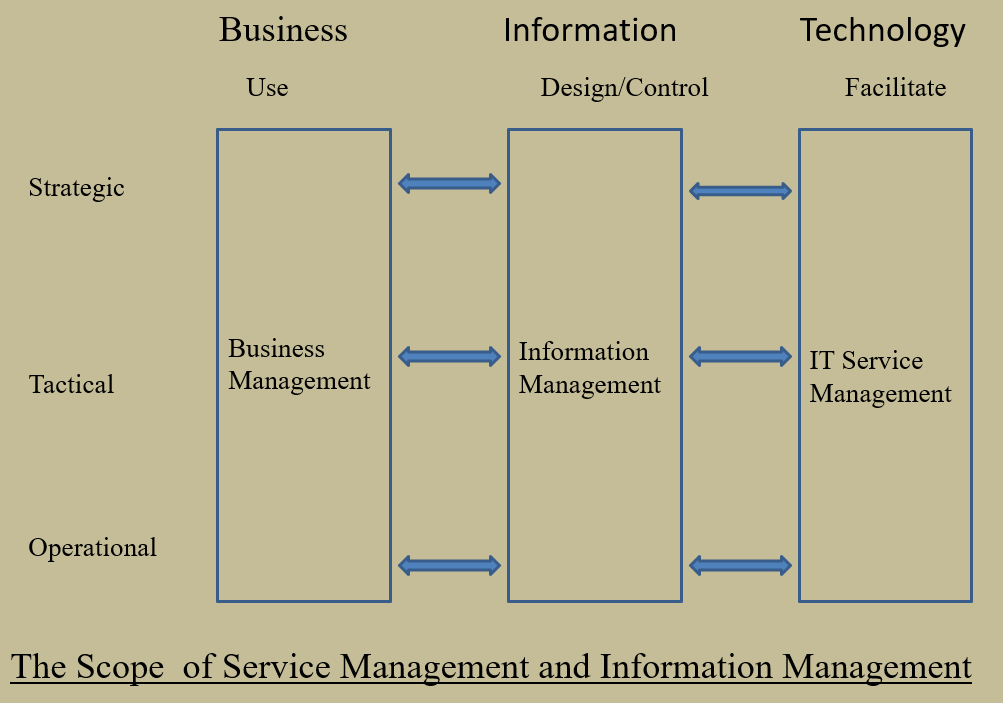 The Scope of Service Management and Information Management
Management Domains
- IT Infrastructure Management
- Responsibility of the technology domain and thus part of the IT Service Management domain
- Information Management
- Not the same as IT Service Management and is complementary to the management domain
- Portfolio, Program, and Project Management
- Portfolios are series of programs which are s series of project
- Application Management
- Deals with applications which is part of the IT infrastructure so is the responsibility of the technology side
- System Management and Network Management
- Management of IT infrastructure so on the technology side
Continue…
- Requirements Management
- Responsibility of the customer, the Business is responsible for the Business Requirements Management and Information requirements managed by the Information domain
- Customer – Provider Relationship
- Present between each two adjacent domains
- Supplier Management
- Present in each domain and works from left to right
- Business – IT Alignment
- Dependent upon both the quality of Information Management and IT Service Management. If Information architecture is not managed correctly, then Technology cannot deliver the right services; if Technology does not provide good services, then Information can still design good information architectures, but it does not help the success of the Business
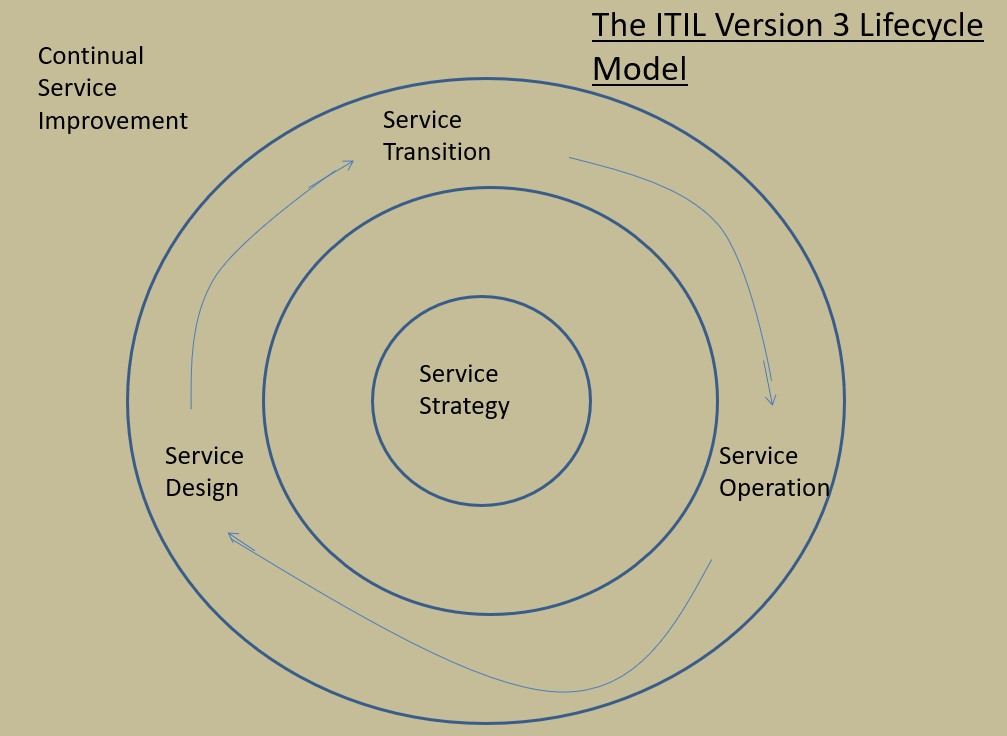 The ITIL Version 3 Lifecycle Model
Processes, Projects, Programs, Portfolios
- Process – is a structured set of activities designed to accomplish a defined objective
- Project – a temporary organization with people and other assets required to achieve an objective
- Program – consists of a number of projects and activities that are planned and managed together to achieve an overall set of related objectives
- Portfolio – a set of project and or programs which are not necessary related brought together for the sake of control, co-ordination and optimization of the portfolio in its totality. A Service Portfolio is the complete set of services that are managed by a service provider
Services
- Services are provided through interaction with the customers and their users
- Services cannot be assessed in advance, only when they are provided
- The quality depends on the way in which the service provider, the customer and users interact
- Can still make changes when the service is being delivered
- Providing a service is a combination of production and use, in which the provider and customer participate simultaneously
Quality Perception – The Gaps
- Between what the customers expect and what the provider perceives caused by a lack of understanding or a misinterpretation of the customer’s needs or desires. Communication can be a great value to close this gap
- Between what the provider thinks customers want and the quality specifications that the provider develops in order to provide the service. Caused by the inability to translate customer requirements into service specifications
- Between the service quality specifications and the service that is actually provided. Caused by provider’s inability to deliver what was good
- Between the actually delivered services and what the customer is told they would receive. Caused by miscommunication and deception
- Between the service that the customers are told to receive and the services they wanted in the first place. Can have many causes. It may be that the customer gets more than they expected to receive, but in most cases this gap draws attention if the service is underperformed and the customer is not satisfied
Quality
- Quality service refers to the extent to which it fulfils the requirements and expectations of the customer
- To provide quality, the supplier must continuously assess how the service is experienced and the customer expects in the future
- What one customer considers normal may be special requirement by another customer
Quality Assurance
- Plan – what, when, who, how it should be done and by using what
- Do – the planned activities are implemented
- Check – determine if the activities provided the expected results
- Act – identify activities that can be improved and pass them over to Plan
Dr W Edwards Deming
- The customer is the most important part of the production line
- Not enough to have satisfied customers, profits come from returning customers who praise your services
- Key to quality is to reduce variance
- Breakdown barriers between departments
- Managers should take responsibilities and provide leadership
- Improve constantly, provide education and self improvement programs
- Institute training on the job
- The transformation is everybody’s job
- Quality management – the responsibility of everybody in the organization aware of how their contribution affects the quality of the work and eventually the services provided by the organization, continuously improving
- Quality assurance – is a policy matter within the organization , the complete set of measures and procedures to ensure that services provided fulfill the expectations of the customer
- The Quality system – is the organizational structure related to responsibilities, procedures and resources for implementing quality management
ISO 9000 Quality Standard
- ISO9001, 9002 – the supplier has an adequate quality system whose effectiveness is regularly assessed by an independent auditor
- The supplier has taken measures to provide the quality agreed with the customer
- Management regularly assesses the operation of the quality system, and use the results to implement improvement measures
- Suppliers procedures are documented and communicated
- Customer’s complaints are recorded, dealt with and use to improve the service
- The supplier controls the production processes and can improve them
Capability Maturity Model (CMM)
- Incomplete process – either is not performed or partially performed
- Performed process- satisfied the specific goals
- Managed process – satisfied (level 1) process that has the basic infrastructure in place
- Defined process – a managed (level 2) process that is tailored from the organization set of standards that contributes to work products, measures and other process improvements
- Quantitative Managed process – (level 4) a process that is controlled using statistical quantitative techniques
- Optimizing process – a level 4 process that is improved based on an understanding of the common causes of variation inherent in the process
CMMI Five Maturity Levels
- Initial - process are ad hoc and chaotic
- Managed - projects of the organization have ensured that processes are planned and executed in accordance with policy
- Defined – processes are well characterized and understood and are described in standards, procedures, tools and methods
- Quantitative Managed – the organization and projects establish quantitative objectives for quality and process performance and use them as criteria in managing processes
- Optimizing – focuses on continually improving process performance through incremental and innovative process and technological improvements
ITSM Benefits to Customer
- The provision of IT services becomes customer focused and agreements about service quality improve the relationship
- The services are described better, in customer language and in more detail
- The quality, availability and cost of the service are managed better
- Communications with the IT organization is improved by agreeing on the points of contract
ITSM Benefits to IT Organization
- Develops a clearer structure, hence more efficient and focused
- IS more in control of the infrastructure and services it has responsibility for and changes become easier to manage
- An effective process structure provides a framework for the effective outsourcing of elements of IT services
- Following best practices encourages a cultural change towards providing service and supports an introduction of quality management systems based on ISO 900o
- Frameworks can provide coherent frames of reference for internal communication and communication with suppliers and for the standardization and identification of procedures
Potential Problems
- Introduction can take a long time and significant effort
- Unnecessary and over-engineered procedures are seen as bureaucratic obstacles
- No improvement in IT service due to fundamental misunderstanding on what processes should provide and controlled
- Improvements in services and cost reductions are insufficiently visible, because no baseline data was available for comparison or wrong targets were identified
- Leaving the development of the process structure to a specialist department may isolate the department in the organization and it may set the direction that is not accepted by other departments
- If there is not sufficient investment in training and support tools, the processes may not improve services and additional resources and personnel may be needed